
Kauffmann, Angelika
Angelica Kauffmann (1741–1807) was one of the most accomplished and internationally successful women artists of the eighteenth century and a major figure in Neoclassicism. Born in Chur, Switzerland, she was a child prodigy, talented in both painting and music, and was trained largely by her father, the painter Joseph Johann Kauffmann. By her teens she was already accepting portrait commissions. Kauffmann traveled extensively through Italy, studying Renaissance masters, classical sculpture, and the developing Neoclassical aesthetic. Kauffmann traveled extensively through Italy, studying Renaissance masters, classical sculpture, and the developing Neoclassical aesthetic. She became particularly interested in history painting—subjects drawn from classical history, mythology, literature, and the Bible. This was unusual for a woman because history painting was considered the most prestigious academic genre, while women were generally excluded from the life-drawing classes considered essential to mastering it. Kauffmann moved to London in 1766 and quickly became fashionable among aristocratic patrons. In 1768 she became one of the 22 founding members of the Royal Academy of Arts. She and flower painter Mary Moser were the only women among the founders.
Her success was considerable. She painted aristocratic portraits, historical and mythological subjects, and decorative compositions. Kauffmann’s paintings combine Neoclassical restraint with a distinctly graceful, sentimental quality. Her figures tend to be idealized rather than dramatically muscular, with flowing draperies, refined gestures, harmonious colors, and carefully controlled compositions. Kauffmann’s classical world is frequently poetic, elegant and emotionally introspective. She was particularly effective at depicting moments of choice, separation, loyalty, love and sacrifice.
Showing the single result
-
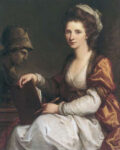
Self-Portrait with the Bust of Minerva
Select options This product has multiple variants. The options may be chosen on the product pageSelf-Portrait with the Bust of Minerva
Angelika Kauffmann